
The short version
- A small prime (23mm or 35mm) is the fastest path to sharper photos and better low-light results.
- A standard zoom is the most flexible “one-lens” solution for travel, family, and learning composition.
- A telephoto zoom expands what you can photograph (wildlife, sports, and distant details) without getting closer.
- For beginners, prioritize autofocus speed, stabilization (when needed), and weather resistance over extreme specs.
- Pick by use-case first, then fine-tune by focal length: 23mm (wide), 35mm (normal), 50mm (portrait).
In this article, you will learn how to choose the best Fujifilm lenses for beginner photography based on what you shoot and how you like to work. We'll cover beginner-friendly prime lenses, versatile zoom options, and a telephoto choice for wildlife and sports, plus practical guidance on focal lengths, aperture, stabilization, and weather sealing. By the end, you'll understand which lens (or two-lens kit) best matches your style and budget: without buying gear you won’t use.
How to Choose Your First Fujifilm Lens (Without Overbuying)
Start with what you photograph most
Beginners often shop by specs, but your subject matter should drive the decision. If you mostly photograph friends, pets, and everyday life, a small prime (like 23mm, 35mm, or 50mm) teaches composition and can reward good technique with crisp detail and smoother backgrounds.
If your photography is more “reactive” (kids running around, travel days, events, hikes) a standard zoom reduces lens changes and helps you learn framing quickly. If you’re drawn to birds, outdoor sports, or distant landscapes, a telephoto zoom is the difference between “tiny subject in the frame” and a photo that actually tells the story.
Understand focal length on Fujifilm APS-C
Most Fujifilm X-mount cameras use APS-C sensors, so focal lengths feel tighter than full-frame. A focal length of 23mm behaves like ~35mm equivalent, 35mm behaves like ~50mm, and 50mm behaves like ~75mm.
This is why 23mm/35mm/50mm is such a popular beginner trio: wide-ish, normal, and portrait: without huge size or cost.
Balance aperture, size, and simplicity
A lens’s maximum aperture affects low-light performance and background blur. f/2 primes are a sweet spot for beginners: bright enough for indoor light, small enough to carry daily, and forgiving enough to learn focus technique.
Zooms trade some brightness for flexibility. That’s not “worse”: it’s a different tool. If you want a deeper explanation of why zoom brightness changes across the range, see our guide to aperture trade-offs in zoom lenses.
Beginner-Friendly Prime Lenses: The Fastest Way to Better Photos
Why primes help beginners learn faster
A prime lens forces you to move your feet and choose your angle: skills that translate to every genre. Primes are also typically sharper and let in more light than similarly priced zooms, which helps you keep ISO lower and shutter speeds faster.
Because primes are smaller, you’re more likely to bring the camera along. That matters more than any lab chart: the best lens is the one that’s on your camera when the moment happens.
23mm vs 35mm vs 50mm: which “first prime” fits you?
23mm is ideal for street, travel, food, and environmental portraits: photos where the background matters. 35mm is a do-everything “normal” lens that feels intuitive for daily life. 50mm is a beginner’s portrait secret weapon: it gives you flattering perspective and easier background separation at the same aperture.
If you’re unsure, 35mm is the safest single-prime choice. If you love storytelling scenes, go 23mm. If you mostly photograph people, pick 50mm.
Autofocus and minimum focusing distance: the hidden specs
Beginners often struggle more with focus than exposure. Pay attention to autofocus motor type and minimum focusing distance, especially if you like food, details, and small objects. A lens that focuses close gives you more creative options without needing a dedicated macro.
Also consider weather resistance if you shoot outdoors. It won’t make a lens waterproof, but it can reduce anxiety when the weather turns.
Top Picks: Best Fujifilm Lenses for Beginners (Compared)
Quick comparison table (beginner decision view)
Use this table to shortlist based on how you shoot. Then jump to the lens-specific sections for real-world strengths and trade-offs.
| Lens | Best for | Why beginners like it | Main trade-off |
|---|---|---|---|
| XF23mm f/2 R WR | Street, travel, everyday scenes | Compact, natural storytelling view, WR | Less background blur than faster primes |
| XF35mm f/2 R WR | Everyday, family, low light | Versatile “normal” perspective, sharp, WR | Can feel tight indoors |
| XF50mm f/2 R WR | Portraits, pets, detail isolation | Flattering perspective, strong subject separation | Needs more working distance |
| XF16-80mm f/4 R OIS WR | One-lens travel + learning | Flexible range, OIS, WR | Slower maximum aperture than f/2.8 zooms and f/2 primes |
| XF18-55mm f/2.8-4 R LM OIS | Everyday, travel, learning composition | Versatile range, OIS, strong image quality for a kit-style zoom | No weather resistance; dimmer at the long end |
How we’re comparing lenses (real beginner priorities)
Beginner lens choices should optimize for consistency: reliable autofocus, manageable size/weight, and predictable results in everyday light. Ultimate corner sharpness matters less than getting the shot and enjoying the process.
We also consider whether a lens helps you learn: primes teach composition; zooms teach framing quickly; telephotos teach timing and stabilization technique.
What “best” means for Fujifilm beginners
“Best” is the lens that fits your most common scenarios and reduces friction. A lens that’s slightly less perfect on paper but lives on your camera will outperform a “perfect” lens that stays in the bag.
If you want a deeper breakdown of zoom categories and when each makes sense, read our related guide on standard vs telephoto zooms.
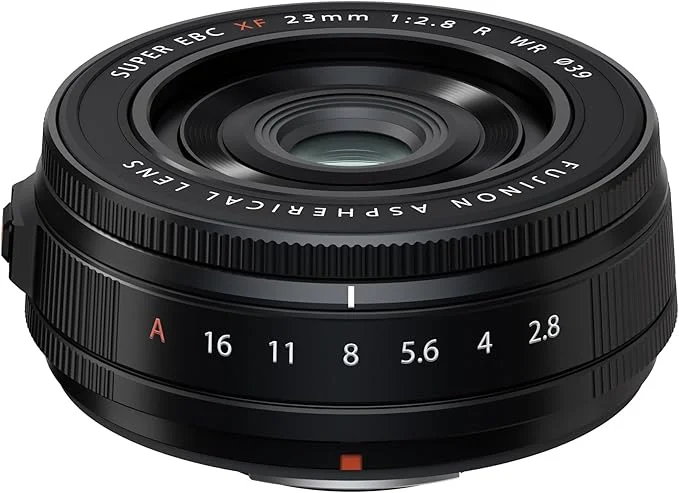
Product 1: Fujifilm Fujinon XF23mm f/2 R WR (Best for Street & Travel Beginners)
Why 23mm is such a beginner-friendly perspective
On Fujifilm APS-C, 23mm gives a natural “I was there” feel that works for street photography, travel, family gatherings, and casual video. It’s wide enough to include context without feeling like an ultra-wide, and it encourages you to get closer, often the simplest way to improve photos.
If you’re learning composition, 23mm helps you practice layering (foreground/midground/background) and using leading lines without making everything look distorted.
Strengths: portability, WR confidence, everyday storytelling
Compact lenses make your camera less intimidating and more likely to come along. With compact form factor and weather resistance, this lens is a strong “always-on” choice for beginners who shoot in unpredictable conditions.
It’s also a great focal length for environmental portraits, showing a person within their surroundings, without needing to stand far away.
Limitations: background blur and low light expectations
At f/2, you can blur backgrounds, but it won’t be as dramatic as faster primes. Indoors at night, you may rely more on ISO or slower shutter speeds, which is where stabilization (in-body or lens-based) and good technique matter.
If your top goal is creamy bokeh for portraits, the 50mm f/2 below will feel more rewarding.
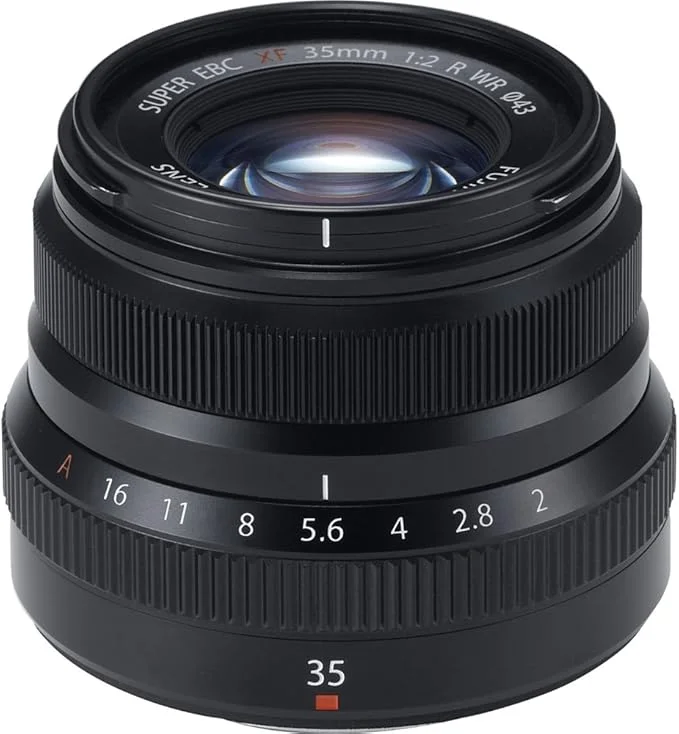
Product 2: Fujinon Fujinon XF35mm f/2 R WR (Best “One Prime” for Most Beginners)
Why 35mm is the safest first prime
35mm on APS-C is the classic “normal lens” view: not too wide, not too tight. It works for portraits, detail shots, street, and everyday life with minimal distortion and a natural sense of depth.
If you want one lens to learn exposure, focus, and composition without fighting perspective, 35mm is the steady middle ground.
Strengths: sharpness, low-light flexibility, and subject separation
At f/2, you gain one stop of light over f/2.8, which can be the difference between a crisp photo and motion blur indoors. You’ll also get more background separation, helping your subject stand out: especially in cluttered environments.
This is also a great lens to practice subject separation without needing extreme focal lengths.
Limitations: tight indoors and “too normal” for some styles
In small rooms, 35mm can feel a bit tight. You may find yourself backing up into walls, which is a sign you might prefer 23mm for home and travel.
And if you love dramatic wide scenes, 35mm can feel understated, though that “understated” look is exactly what many photographers grow to love.
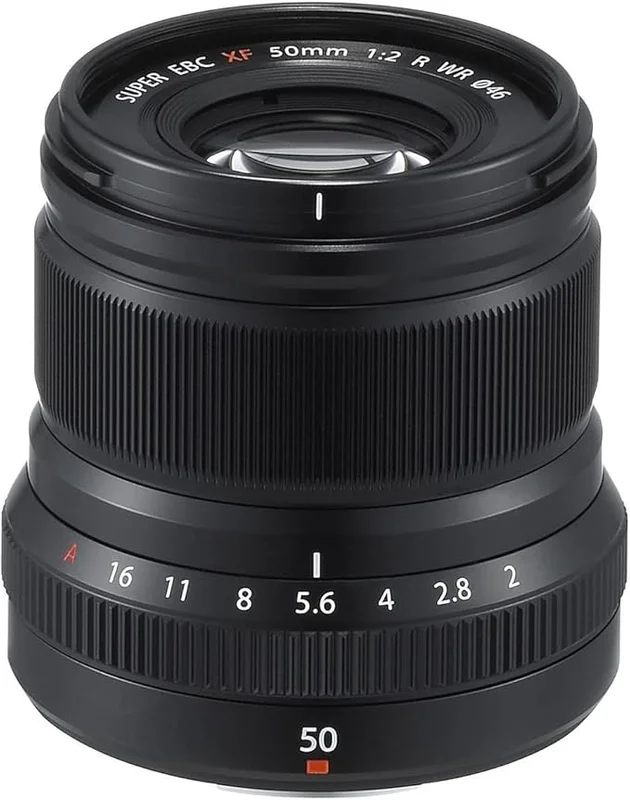
Product 3: Fujifilm Fujinon XF50mm f/2 R WR (Best Beginner Portrait Lens)
Why 50mm (75mm equivalent) flatters faces
Perspective matters more than most beginners realize. At this focal length, facial features often look more natural than they can at wider angles, and you don’t need to be uncomfortably close to your subject to fill the frame.
It’s also excellent for candid portraits because you can shoot from a little farther back, helping people relax.
Strengths: bokeh, detail isolation, and simple backgrounds
With f/2 and a longer focal length, you can create stronger background blur: often described as bokeh. This makes messy backgrounds look cleaner and more professional, which is a huge confidence boost for beginners.
It’s also a strong choice for pets, product-style photos, and compressing scenes in a pleasing way.
Limitations: working distance and camera shake
You’ll need more space to frame your subject, especially indoors. That’s not a flaw. It’s just how portrait focal lengths behave. If you mostly shoot in tight spaces, 35mm will be easier.
Also, longer focal lengths show camera shake more clearly. Watch your shutter speed and consider the reciprocal rule as a starting point.
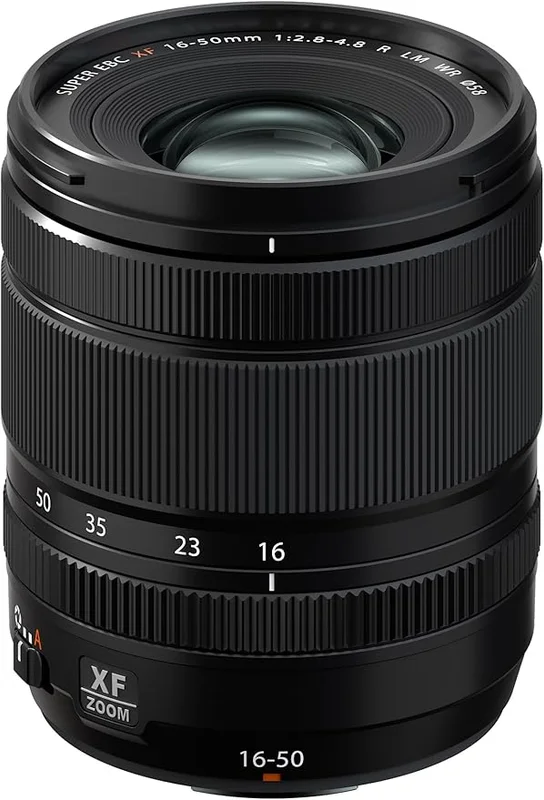
Product 4: Fujifilm Fujinon XF18-55mm f/2.8-4 R LM OIS (Best One-Lens Kit for Beginners)
Why a standard zoom accelerates learning
A standard zoom lets you experiment with framing instantly: wide for landscapes and interiors, mid-range for daily scenes, and short telephoto for portraits. That flexibility is powerful when you’re still discovering what you like to shoot.
It’s also the easiest way to practice composition drills, shoot the same subject at multiple focal lengths and compare how the background and perspective feel.
Strengths: range, OIS, and everyday versatility
This lens covers the core focal lengths most beginners use. It includes optical image stabilization (OIS), which can help reduce blur from camera shake in handheld shooting.
Limitations: variable aperture and no weather resistance
This lens uses a variable aperture, so it becomes less bright as you zoom in. That’s normal for compact zooms, but it means your camera may raise ISO or slow shutter speed unexpectedly if you shoot in auto modes.
Also note that the XF18-55mm is not weather resistant, so if you frequently shoot in rain or dusty conditions, a WR zoom like the XF16-80mm f/4 R OIS WR may be a better fit.
Product 5: Fujifilm Fujinon XF16-80mm f/4 R OIS WR (Best Travel/Walkaround Zoom with WR)
What this zoom unlocks for beginners
Compared to shorter kit-style zooms, the 16–80mm range gives you more flexibility for travel: wider coverage at the short end and more reach for portraits and details at the long end.
Strengths: OIS, WR, and broad focal-length range
Optical stabilization (OIS) helps offset hand shake in handheld shooting. That doesn’t freeze subject motion, but it can make handheld shooting more realistic in moderate light.
For beginners, the combination of range + OIS + WR is a strong outdoor package, useful for travel, hiking, and everyday walkaround photography.
Limitations: f/4 maximum aperture
With a constant f/4 maximum aperture, you’ll often need more light or higher ISO than you would with an f/2 prime or an f/2.8 zoom, particularly indoors or near dusk.
Best Starter Kits (Lens Combos) for Common Beginner Goals
The “learn fast” two-lens kit: 23mm + 50mm
This pairing covers storytelling wide/normal scenes and flattering portraits. Use 23mm for travel, street, interiors, and daily life; switch to 50mm when you want cleaner backgrounds, candid portraits, and detail isolation.
It’s a simple kit that teaches you how focal length changes the feel of an image: without overlapping too much.
The “one lens only” kit: XF18-55mm or XF16-80mm
If you want maximum flexibility with minimal decisions, a standard zoom like the XF18-55mm f/2.8-4 R LM OIS or XF16-80mm f/4 R OIS WR is a practical single-lens solution. The XF18-55mm is brighter at the wide end; the XF16-80mm adds weather resistance and more reach.
Once you identify your favorite focal length from your metadata (EXIF), you can add a prime later that matches it for better low-light performance and more background blur.
Beginner Settings & Techniques That Make These Lenses Shine
Use Auto ISO with a minimum shutter speed
Beginners often get blurry photos because the camera chooses a shutter speed that’s too slow for people or pets. Set Auto ISO with a minimum shutter speed (or a “minimum shutter speed” auto setting, depending on your Fujifilm body) so the camera raises ISO before it drags shutter speed too low.
This matters most with longer focal lengths, where small hand movements become obvious blur.
Practice focus modes: AF-S, AF-C, and face/eye detection
Use AF-S for still subjects, AF-C for moving subjects, and enable face/eye detection for portraits. If you’re shooting kids or pets, AF-C plus a modest burst rate can dramatically increase keeper shots.
Also pay attention to focus breathing if you shoot video; it’s not a dealbreaker, but it affects how “cinematic” focus pulls feel.
Stabilization: what it helps (and what it can’t)
Optical image stabilization helps with camera shake, not subject movement. For wildlife or sports, you still need fast shutter speeds to freeze motion, so prioritize shutter speed first, then let ISO rise as needed.
For travel and landscapes, stabilization can let you shoot handheld at slower speeds, which is useful at dusk or indoors where tripods aren’t practical.
Questions
Which Fujifilm lens is best for a complete beginner?
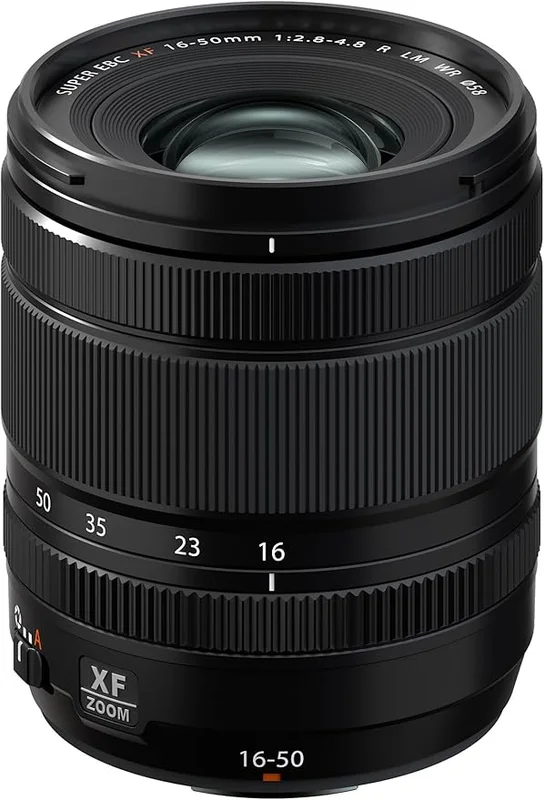
If you want one prime to learn with, the XF35mm f/2 R WR is the most universally useful focal length and aperture combination. If you want one lens to do everything reasonably well, the XF16-50mm f/2.8-4.8 is the most flexible choice. The “best” depends on whether you prefer simplicity (prime) or versatility (zoom).
Is 23mm too wide for portraits on Fujifilm APS-C?
23mm can work for environmental portraits where the background is part of the story. For close-up headshots, it can exaggerate facial features if you stand too close. If portraits are your priority, 50mm is usually the more flattering beginner choice.
Should beginners buy a zoom or a prime first?
A zoom is better if you’re still discovering what you like to shoot and want one lens for many situations. A prime is better if you want improved low-light performance, more background blur, and faster skill-building in composition. Many beginners end up happiest with a zoom first, then a prime that matches their favorite focal length.
Do I need weather-resistant (WR) lenses as a beginner?
You don’t need WR, but it’s genuinely helpful if you shoot outdoors, travel often, or live in rainy/dusty areas. WR reduces worry and can keep you shooting when conditions aren’t perfect. Just remember WR isn’t the same as waterproofing.
Is the 70-300mm too hard to use for beginners?
It’s more demanding than a standard zoom because it needs faster shutter speeds and steadier technique. That said, stabilization helps, and it’s an excellent learning tool for tracking moving subjects. If wildlife or sports is your main interest, it’s a very reasonable early purchase.
How we researched this
On Nov 3, 2026 we checked the 19 factual statements in this guide (specs, numbers and comparisons) against the sources below. 11 were confirmed. 8 could not be confirmed from these sources yet.
- FUJINON XF16-80mmF4 R OIS WR | Lenses | FUJIFILM X Series & GFX - Global · fujifilm-x.com
- Fujinon XF23mm f2 R WR review | Digital Camera World · digitalcameraworld.com
- Fujinon XF 18-55mm f/2.8-4 R LM OIS Review - Imaging Resource · imaging-resource.com
- Fujinon XF 50mm f/2 R WR Review - Imaging Resource · imaging-resource.com

Photographer and video producer since 2008, with editorial work for Forbes and the Tribeca Film Festival and brand work for Disney, Apple Pay and Burton. He has shot every Canon 5D, Hasselblad and Phase One medium format, and works on a Sony FX3 today. In Denver he runs the content for UFC lightweight Drew Dober and for Easton Online, a consultancy for gym owners. More about Jeff